
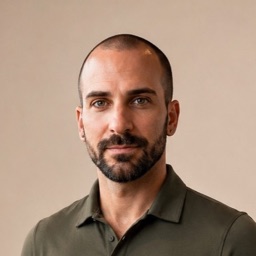
Matteo Campagna
Archer. Kinesiologist. Performance analyst.
My name is Matteo Campagna and I am an archer, kinesiologist and performance analyst. I work with archers, coaches and clubs to understand what is really happening in the shot, starting from data rather than from feel. I publish my research on archery in the Lab.
My story
I stopped competing when I realised science was explaining things neither I nor my coach could see with the naked eye.
For years I competed. I hit every plateau there is, and tried everything there was to get past them. What finally changed things was starting to measure, instead of trusting what I felt. That is my work now: helping other archers measure the right things. I come from the shooting line, not just from research, and it shows.
I started on the range, as an archer, and I came to know every kind of day that anyone who shoots recognises at once: the days when the movement comes naturally, without having to think about it, and the days when nothing seems to work, for no reason you can put into words. It was exactly that "can't explain it" that brought me to where I am today. For years I treated it as a limitation; at some point I realised it was actually the question worth starting from.
For a long time those questions went unanswered. Why do two archers who train in exactly the same way improve at different speeds? Why does a movement that looks clean at the start of a session break down by the end, when fatigue sets in? Why do certain errors keep coming back even after you have corrected them ten times? I did not have the tools to answer, so I decided to go and get them, approaching the problem from the side of human movement rather than shooting technique alone.
I built my education around that. A bachelor's degree in Sports and Exercise Science at the Università di Bologna, with a thesis on motor learning applied to archery; then a master's degree with honours in Preventive and Adapted Physical Activity at Urbino, and a specialisation in functional rehabilitation. During those same years I worked as a kinesiologist, conditioning coach, and lecturer, and since 2019 I have worked with FIARC, the Italian field archery federation, as an instructor and educational collaborator, bringing biomechanics and motor learning into its training circuit.
MCPerformance grew out of all of this coming together: concrete experience in preventive, rehabilitative, and performance exercise, years in the lab, hands-on work with the body, and an obsession with measuring what archery, until recently, left to "in my opinion".
There is also a side of me that, on the surface, has nothing to do with archery. I come from a computing background, and I never really stopped programming. Over the years the two worlds converged: rather than make do with software built for other sports that never asked the right questions, I built my own. That is how Eyercer came about, the program I use to read the shot frame by frame, and ARCOS, the system I am developing to read archers' reliability, consistency and load across a whole federation, starting from the competition results that already exist. I write them myself, line by line, precisely because I know this work from the inside: I know which numbers actually matter on the shooting line and which do not. They are tools made to measure by someone who does that trade every day.
One thing, though, I want to say upfront: I am not a replacement for your shooting coach, and I have no intention of being one. I work alongside them, not instead of them. What I bring is a biomechanical and performance reading that the coach usually does not have the tools to provide: the same reading that explains why certain corrections fail to stick, or why errors that look purely technical are, when you look closely, coming from the body.
In the end the point is not to shoot more. It is to understand exactly what is limiting your shot.
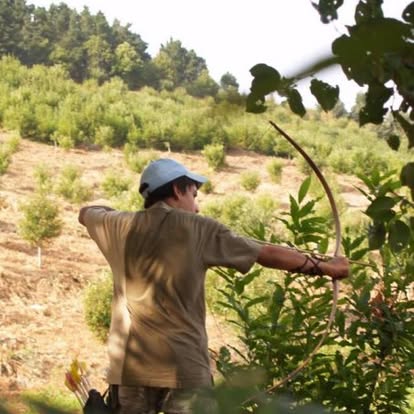
Qualifications and roles
- Education
-
- Master's degree (LM-67) in Preventive and Adapted Physical Activity, specialisation in functional rehabilitation, Università degli Studi di Urbino "Carlo Bo", 2019-2021, 110/110 with honours. Thesis on biomechanics and physical preparation applied to archery.
- Bachelor's degree in Sports and Exercise Science, Alma Mater Studiorum Università di Bologna, 2015-2019. Thesis on motor learning and performance in archery.
- Roles
-
- Instructor and educational collaborator, education department of FIARC (Federazione Italiana Arcieri Tiro di Campagna), since 2019.
- Independent performance coach for archery and precision sports, since 2021.
- Kinesiologist (LM-67), conditioning coach and personal trainer.
- Independent researcher in archery performance.
- Founder of MCPerformance, 2026.
- International
- Volunteer attaché to the Danish national team at the European Youth Olympic Festival (EYOF) in Skopje, July 2025.
- Archery
- Archer since 2003; competed with the longbow until 2012.
Research and teaching
I write essays, manuals and studies, and I carry out independent research on archery performance. The questions come from the range: how well a competition rule can identify the more precise archer, why a movement that used to run by itself stops coming, how you measure an archer's consistency. For each piece of work I state what kind of work it is and what data it rests on, and in the essays I also set out where they could be wrong. When it contains a testable prediction, I record it with its date in the prediction register and leave it untouched: it stays there until the data show whether it held. The essays deposited on Zenodo have a DOI, and my author identifier is ORCID 0009-0000-7314-3967.
ARCOS
-
ARCOS · Archery Reliability & Consistency Operating System
It is meant to take archery from the data competitions already produce to decisions that are still made on intuition, with arrow-by-arrow scoring, consistency and load metrics, and reports for archers, coaches and federations. It is a system in development, and the online demo runs on fictional data. It is not a medical tool.
Essays
-
When Nobody Won: ties, competitions and seasons in archery
It asks which tie-break rule best identifies the better archer, and what changes when the question widens to the tournament and the season. Matches are computed exactly, while tournaments and part of the season are simulated, with no real competition data; its two predictions are waiting for independent data.
-
The shoot-off in archery: how much is one arrow worth?
It measures how often, out of a hundred shoot-offs between two archers of different ability, the single arrow picks out the more precise one. Everything comes from the target geometry, the format rules and a model of shot dispersion, with no competition data, and the reproduction package lets you redo the calculations.
-
Target panic as the de-automatization of a ballistic act
It offers an answer to why an expert archer at full draw finds that the release will no longer come. The answer is my own hypothesis, de-automatization, built on the existing explanations and not yet tested directly: that is why it carries seven predictions that could refute it.
-
The set system in archery: the mathematics of who wins
It compares how often the set system and the old cumulative score point to the more precise archer. The model is deliberately spare and uses no real archers' scores; every number was recomputed by a second, separate implementation, and this one also has a reproduction package.
Other Lab work
-
ARCHEON
It is an experimental challenge format, faster and more tactical, with a 10-second shot clock per arrow and three game mechanics. The rulebook has to be tried out on the range, and it is waiting for reports from the clubs that test it.
-
Pre-anchor block and premature string release
It reports the case of a single archer whose string slips away before anchor: the functional assessment and the return-to-shooting plan, published in anonymised form. It shows the method on one case, not a rule that applies to everyone.
Manuals and tools
- Technical manuals on errors in the archery shot and on archery biomechanics, in technical and editorial review.
- Eyercer, the software and workflow I use to draw statistical consistency metrics from video, along with performance trends over time and the recurring patterns and systematic errors in the shot.
Teaching
Since March 2019 I have taught for the FIARC education department: biomechanics, motor learning and control, training methodology and warm-up protocols applied to archery, on instructor courses and masterclasses. I design and update the course content, handouts and slides, and I help develop the education plan.
In 2027 I will be one of the lecturers at the IFAA Youth Camp, an international summer camp on performance for young people, coaches and staff from several countries: the appointment is confirmed. Over the years I have also trained new trainers in the centres where I worked, and taught biology, anatomy and nutrition at a private upper-secondary school in Bologna.
Profiles
My path
I started shooting before I even knew what performance meant. From there it was a long series of questions I couldn't answer. So I decided to start studying.
First, the shooting
Everything started at the range: arrows, repetition, weeks of training, competitions, and those errors that keep coming back at the same point for reasons you cannot quite pin down in the moment.
Archery looks like a static sport, but it is the exact opposite. Every arrow is a fragile balance of posture, alignment, hand control, visual attention, and the ability to repeat the same movement in conditions that shift ever so slightly each time. When everything falls into place, it feels like the simplest thing in the world; when something goes wrong, understanding what is almost always the hard part. It was in that gap, between the shot that works and the one you cannot explain, that I spent my years as an athlete.
The questions the target doesn't answer
The more I competed, the clearer one thing became: the score tells you what happened, but almost never why. A poor grouping can come from five different causes: the shoulder giving way, the forearm locking up, the head shifting by the smallest amount, attention dropping in the last end, the breath losing its rhythm. The target gives you the effect and keeps the cause to itself.
This is where the core of how I work comes from: not stopping at the visible error. Saying "you plucked" is easy. Understanding why you plucked on that specific arrow, at that moment in the session, with that draw weight and in that physical condition, that is the real challenge. And it was ultimately this question that convinced me to study properly, rather than settle for shooting more.
University
I built my education around exactly those questions. First a bachelor's degree in Sports and Exercise Science at the Università di Bologna, with a thesis on motor learning in archery; then a master's degree with honours in Preventive and Adapted Physical Activity at Urbino, and a specialisation in functional rehabilitation. In between, five years spent on exercise physiology, biomechanics, motor control and learning, functional anatomy, athletic conditioning, and injury prevention.
But the part that really interested me came after the exam: taking all that theory and bringing it into the shooting range in a form that would actually be useful, not as an academic paper. Translating, cutting what was superfluous, deciding each time what to leave in the lab and what could genuinely help an archer on competition day.
Science on its own doesn't make anyone shoot better. But it stops you from working by trial and error, and that alone usually counts for a lot.
On the range, in the gym, in the classroom
While I was studying, I was working. At first as a personal trainer and kinesiologist, with people and athletes from different sports; then increasingly focused on archery. That is where the work became targeted: the strength the movement actually requires rather than the kind that just adds bulk, scapular stability, core control, thoracic mobility, shoulder health, and above all the ability to maintain technical quality when fatigue arrives, because it is at that moment, not when fresh, that most competitions are decided. That is the point where the gym stops being a world apart from the range and starts speaking its language.
Since 2019, alongside this, I have been teaching for FIARC as an instructor and educational collaborator, and teaching had a side effect I had not expected: it forces you to be clear. And in archery, being clear means, first of all, separating what is genuinely useful from what we repeat only because it has always been done that way. Not everything you hear at the range is wrong, mind you. But not everything is precise enough to build a serious athlete's performance on top of it.
MCPerformance
In 2026 I gave all of this a name: MCPerformance. It is how I bring my work to archers, Italian ones and, increasingly, international ones as well. In practice that means biomechanical assessment, physical preparation built around the individual, performance testing, and reports you can actually read without needing a degree to understand them.
Meanwhile the work has started taking me abroad as well: in July 2025 I was lucky enough to serve as a volunteer attaché to the Danish national team at the European Youth Olympic Festival in Skopje, one of those international settings you always come back from with something to bring to your own athletes. And when I am not at the range, I write: I have manuals in technical and editorial review, and others already in progress.
I work with archers, coaches, and clubs that want to leave behind the old "observe and correct" and try a more solid method, one where every decision comes from something that has first been measured. The cycle is always the same, and it works because it closes on itself:
observe and measure, interpret, intervene, verify. Then start again.
Approach
I don't analyse archery from the outside. I analyse it knowing what it means to stand there, on the line, with the string in your hand.
I start from a very simple idea: what you cannot observe, measure, or interpret, you will struggle to improve. This does not mean reducing an archer to a table of numbers; that would be the surest way to lose sight of the person. It means the opposite: using data to understand them better.
An athlete, in the end, is not their score. They are the way they build the movement, how they hold their posture as the ends accumulate, how they manage draw and breath, how they recover between arrows, how they react when tiredness sets in and how they change, often without noticing, on competition day. Archery is a precision sport that, paradoxically, is almost always trained with imprecise tools. My job is to make that process more readable, line by line.
-
Measure, then correct
Before changing anything I need to understand what is really happening, because the technical error you can see is almost always the end of a chain: fix only the last link and it works for a few arrows, then the problem comes back unchanged. That is why I start from physical, video and functional assessments rather than from an on-the-fly diagnosis.
-
Body and technique are inseparable
In archery, technique lives inside a body. If the scapula cannot control its position, if the thorax is stiff, if the core does not hold, the movement changes even when the archer knows perfectly well what they should be doing. The body is the infrastructure everything else rests on.
-
Train what you need, not what you want
An archer's gym is not a CrossFit gym, because being strong is not enough: you need strength specific to the movement, stability, isometric endurance and sensitivity. An archer must be strong without becoming rigid, stable without locking up, and able to last without losing feel.
-
Evidence, not opinion
When scientific literature has an answer, I use it. When it does not, you work from principles, observation, measurement, and progressive verification. Archery carries a lot of beliefs handed down over decades: some are rock solid, others are half-truths that have been repeated too many times. My job is to separate the two.
Areas of work
-
Shooting biomechanics
Posture, body-bow-target alignment, scapular control, draw line, anchor, follow-through. I am not looking for "the perfect movement" in the abstract. I am looking for the most stable movement for the real archer in front of me, with the body they have.
-
Sport-specific physical conditioning
Back, scapula, shoulder, thoracic mobility, core, and preventing neck and lower-back problems. There is one goal: to hold the same technical setup even when fatigue arrives, when pressure mounts, or when both arrive at once.
-
Movement kinematics
Set-up, draw, anchor, expansion, release, follow-through. Oscillations, angles, asymmetries. Video is not for show: it is for making better decisions about what to change and what to leave alone.
-
Motor learning
How the athlete learns, modifies, and consolidates a movement. Quality of feedback, routine building, progression, variability. Repeating an error many times does not correct it: it stabilises it.
-
Visual training and attention
Quiet eye, attentional stability, visual timing, the relationship between aiming and release. A few eye exercises are not enough: you first need to understand whether the visual component is actually the limiting factor for that athlete. Often it is not.
-
Periodisation and load management
Macro, meso, micro. Weekly arrow volume, integration with gym work, deload weeks, preparation for target competitions. Transforming training from "accumulating arrows" into an organised process.
-
Load, recovery, overload prevention
Load monitoring, fatigue management, overuse issues, shoulder, cervical spine, thoracic stiffness. An archer who trains a lot but recovers poorly is not building performance: they are simply accumulating risk.
-
Target analysis
Grouping, error direction, pattern recurrence, differences between the start and end of a session, training versus competition. The target gives you the effect. Video gives you the behaviour. The body gives you the cause. Serious work means putting all three together.
-
Field-based performance indices
I assess an archer's performance directly where they shoot, using my own methodology, built and refined over the years. Not lab tests that stay far removed from real competition, but measurable, repeatable field indices that say something concrete about where you are and what is worth working on.
Who I work with
For archers
I help archers understand their own movement better, identify physical and technical limitations, build a training plan that makes sense, and maintain quality even when fatigue sets in.
- They train a lot but have been stuck for months
- They have errors that keep coming back unchanged
- They want to integrate gym work and shooting seriously
- They have stiffness or compensations that are getting worse (where there is pain, I work alongside their doctor or physiotherapist)
- They want to improve stability and repeatability
- They are tired of working by feel
For coaches
I work alongside the shooting coach, never instead of them. They guide the technical build; I bring the biomechanical and physical reading of the athlete's body, which often explains why certain corrections fail to consolidate.
Particularly useful when the athlete understands the correction perfectly but cannot hold it. Or when an error looks technical but is actually physical or coordinative.
For clubs
With clubs and sports organisations I can build:
- Group assessment days
- Physical screening for archers
- Workshops on biomechanics and conditioning
- Programmes to prevent overload
- Training for the club's coaches
- Monitoring protocols
- Individual and group reports
My vision
Archery deserves a more modern performance culture.
Not because everything that exists today is wrong. Far from it: I build on the work of those who came before me, on those who brought this sport to where it is now. But we have tools, evidence, and methods that did not exist twenty years ago, and they can help athletes and coaches work better. Leaving them unused, today, is a waste.
Archery is technique, mind, body, and equipment all at once. Remove even one of these components and you lose the full picture. An archer who truly performs is not the one who shoots well when everything runs smoothly. It is the one who maintains quality even when the wind shifts, fatigue arrives, tension rises, or the body is not at 100%.
Registry updates by email
At most one email a month, sent only when something has changed: claims that change status, new claims, Lab predictions registered or resolved, new studies and new books.
Sign-ups are handled by Systeme.io, the service that runs the newsletter. Every email has a link to unsubscribe with one click.